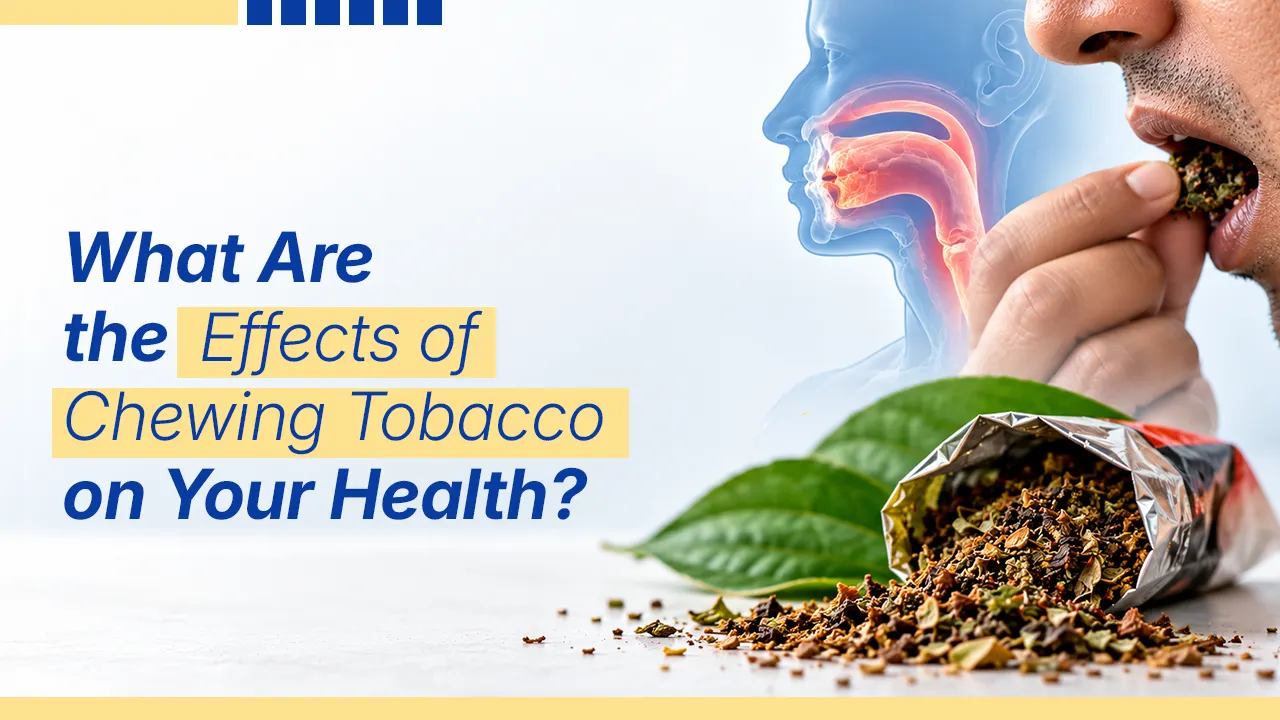
For millions of people across India, chewing tobacco is part of the daily routine. It might be gutka after lunch, khaini during a break, or zarda tucked into a paan on the way home. Because it has become a routine, the health risks can easily be overlooked. But the side effects of chewing tobacco are serious, well-documented, and in many cases irreversible.
India has the world’s largest smokeless tobacco market [1]. The Global Adult Tobacco Survey (GATS-2, 2016-17) found that 28.6% of Indian adults use tobacco, and 21.4% (about 199 million people) use it in smokeless or chewing form [4]. India records nearly 119,000 new oral cavity and pharynx cancers a year, and at least 90% are caused by tobacco use in some form [1]. If you or someone you know chews tobacco regularly, understanding what it does to your body is the first step toward making an informed decision about your health.
Key Insights
- Learn what chewing tobacco does to your body: it contains 36 known cancer-causing chemicals that damage your mouth, gums, heart, and reproductive health [1].
- Understand the scale of tobacco use in India: about 199 million adults (21.4%) use smokeless tobacco [4], and oral cavity and pharynx cancers affect nearly 119,000 people a year, at least 90% of them caused by tobacco [1].
- Recognise how addiction develops: nicotine creates a chemical dependency reinforced by cultural habits, low cost, and early exposure [1].
- Know how to quit and where to get help: nicotine replacement therapy, behavioural support, and India’s free National Tobacco Quitline (1800-11-2356) are all available [5].
What Does Chewing Tobacco Do to Your Body?
QUICK ANSWER
The side effects of chewing tobacco can impact nearly every part of your body. Tobacco sits directly against your gums and cheek lining, exposing your tissues to nicotine and 36 cancer-causing chemicals [1]. The chewing tobacco effects build over months and years.
Mouth and throat:
- White or red patches inside the mouth (leukoplakia or erythroplakia), which are pre-cancerous warning signs
- Receding gums, tooth decay, and tooth loss
- Sores and ulcers that refuse to heal [1]
Heart and circulation:
- Raised heart rate and blood pressure with every use
- Higher risk of heart attack and stroke [1]
Digestive system:
- Higher risk of cancers of the oesophagus (food pipe) and pancreas [1]
Reproductive health:
- May reduce fertility in both men and women
- Increased risk of premature birth and low birth weight during pregnancy [1]
If you have mouth sores that do not heal within two to three weeks, persistent jaw pain, difficulty swallowing, or a neck lump, see a doctor without delay.
People sometimes search for benefits of chewing tobacco, believing it helps with stress or digestion. There is no clinical evidence for either claim. Nicotine may create a brief feeling of calm, but this is only a temporary effect of nicotine, not a health benefit. The damage far outweighs the sensation.
How Are Chewing Tobacco and Oral Cancer Connected?
QUICK ANSWER
Chewing tobacco causes oral cancer. The link between chewing tobacco and oral cancer is extensively documented. A five-year study of rural Indian men found smokeless tobacco users were 4.5 times more likely to develop oral cancer than non-users [2]. India bears the highest burden of oral cancer worldwide [1].
The risk increases with:
- Frequency: higher daily use raises cancer risk significantly [2]
- Duration: years of continuous use compound the cellular damage
- Combination with other substances: mixing tobacco with areca nut (supari), lime (chuna), or betel leaf intensifies the carcinogenic effect. Gutka carries an especially high risk of oral submucous fibrosis (OSMF), a pre-cancerous condition that stiffens the tissue inside the mouth [1]
People often wonder about chewing tobacco vs smoking. Here is how they compare:
Both cause cancer. Neither is a safer alternative [1].
Why Is Chewing Tobacco So Addictive?
QUICK ANSWER
Chewing tobacco addiction develops through nicotine, the same chemical that makes cigarettes addictive. When you place tobacco in your mouth, nicotine absorbs through your cheek lining and reaches your brain, triggering a release of dopamine (your brain’s reward chemical) [1].
With repeated use, your brain can produce less dopamine on its own and begins relying on tobacco to feel normal. This is a dependency.
In India, several factors make this addiction particularly deep-rooted:
- Cultural normalisation: tobacco is offered at social gatherings, after meals, and during work breaks
- Low cost: gutka and khaini packets cost very little, making daily use financially effortless
- Early exposure: the GATS-2 survey found that the average age of starting tobacco use in India is between 17 and 18 years [4]
What Are Chewing Tobacco Withdrawal Symptoms?
QUICK ANSWER
When you decide to stop, understanding chewing tobacco withdrawal symptoms helps you prepare. Withdrawal begins within 4 to 24 hours and usually peaks in the first 3 days [3]:
- Strong cravings for tobacco
- Irritability, restlessness, and difficulty concentrating
- Anxiety and low mood
- Increased appetite
- Headaches and disturbed sleep
Symptoms usually become less intense over the first month [3]. Cravings in trigger situations, like after meals or during commutes, can last longer but become easier to manage with support. If low mood becomes severe or you have thoughts of self-harm, call 112 or contact Tele-MANAS on 14416 or 1-800-891-4416.
What Is the Most Effective Way to Quit Chewing Tobacco?
QUICK ANSWER
Quitting chewing tobacco combines practical habit change with behavioural support, and a doctor may add medication where appropriate [3]. Counselling is the foundation, and evidence for medication in smokeless tobacco users is still limited. A set quit date, a plan for your triggers and support from people close to you all help.
Here is what works:
- Set a quit date within the next two weeks.
- Tell people close to you. Accountability helps more than most people expect.
- Ask a doctor whether nicotine replacement therapy (NRT) could help ease cravings while your body adjusts [3]. Evidence for smokeless tobacco users is still limited, so counselling and support remain the foundation.
- Identify your triggers. Plan alternatives: sugar-free gum, fennel seeds (saunf), cardamom (elaichi), or a glass of water.
- Get professional support. CBT (cognitive behavioural therapy) helps manage the thought patterns that drive relapse.
Keeping your mouth busy with healthy alternatives during the first few weeks can help reduce the urge. India’s National Tobacco Quitline (1800-11-2356) provides free counselling through the Ministry of Health and Family Welfare [5].
Addiction and Mental Health Support at Jagruti Rehabilitation Centre
Many people try to quit on their own several times before seeking professional help. That is normal, and it does not mean you have failed. If chewing tobacco addiction has become difficult to manage, or if previous attempts to quit chewing tobacco have not lasted, a clinical programme, like the one at our rehab centre in Gurgaon, adds the medical and psychological support that makes lasting change more likely.
At Jagruti Rehabilitation Centre:
- Psychiatrist-led assessment to understand your dependency pattern and design a personalised quit plan
- NRT and medication management monitored through regular follow-ups
- CBT and motivational interviewing to address the behavioural side of addiction
- Family sessions, so the people around you understand the condition and know how to help
- Residential options for those who need distance from daily triggers during the early weeks
To speak with the clinical team, call +91-9822207761. Quitting is hard, but many people do it, and your body starts recovering from the day you stop. The right support makes the difference between trying again and staying tobacco-free.