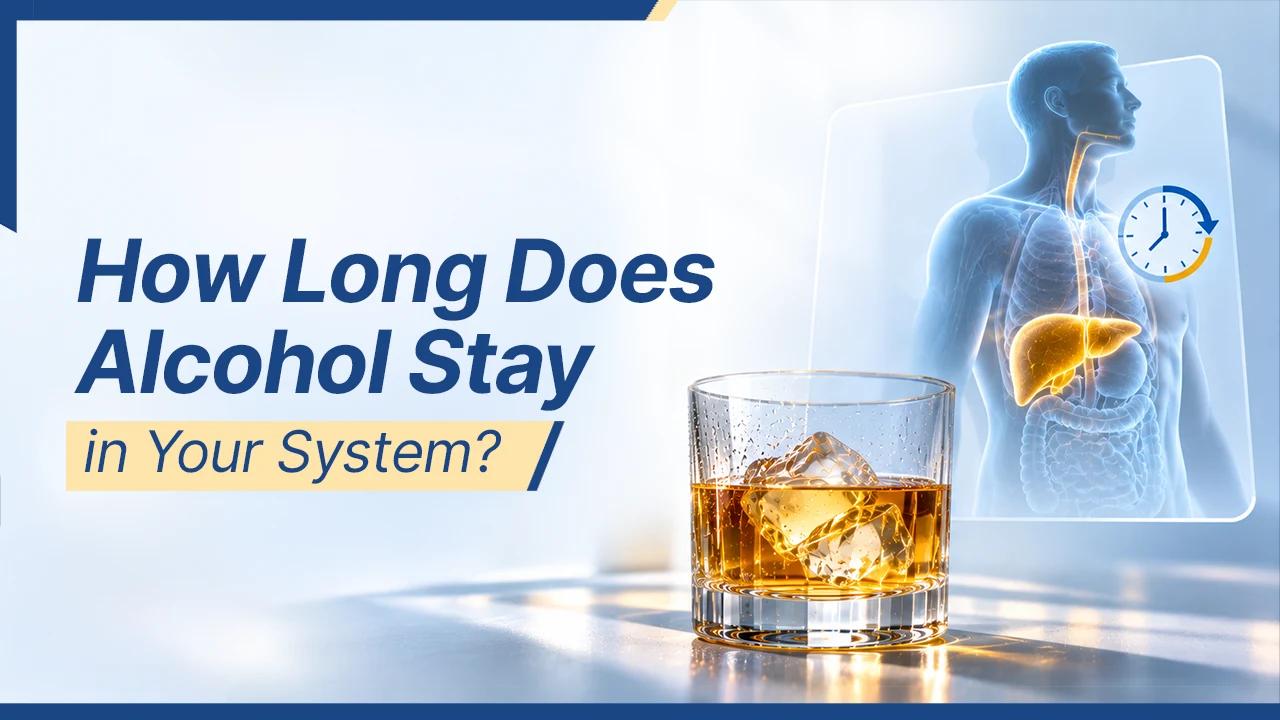
A medical test the next morning, a workplace screening later in the week, or simply trying to understand what the body is still processing after last night. There are plenty of reasons someone might look up how long does alcohol stay in your system? It's a common question, and wanting to understand how alcohol leaves the body doesn't necessarily mean there's a problem.
The liver breaks down most of the alcohol you consume using enzymes like alcohol dehydrogenase (ADH). Alcohol is eliminated at a relatively steady rate, but the speed varies between individuals depending on liver size, body mass and genetics [1]. The body generally processes around one standard drink per hour, but this is only a rough estimate, not a guaranteed timeframe. Drinking more than your body can break down allows alcohol to build up in your bloodstream [5].
Key Insights
- Learn how long alcohol stays detectable in blood, breath, urine, and hair, and why each test has a different window.
- Understand how the liver processes alcohol and why the time it takes varies from person to person. One standard drink per hour is a rough estimate, not a fixed rule [1].
- Recognise the factors that influence blood alcohol levels and clearance: body weight, body composition, biological sex, liver health, food intake, and the total amount consumed.
- Know that needing to calculate these windows regularly is itself a pattern worth discussing with a doctor.
How Long Is Alcohol Detectable in Different Tests?
Quick Answer
Alcohol can be detected in blood for up to 12 hours, while breath and standard urine tests may detect it for around 12 to 24 hours. EtG urine tests (ethyl glucuronide, a byproduct the liver produces during metabolism) detect traces for 72 to 80 hours. Hair tests have the longest window at up to 90 days [2].
| Test Type | What It Measures | Approximate Detection Window |
|---|---|---|
| Blood | Ethanol in bloodstream | Up to 12 hours [2] |
| Breath | Alcohol vapour in exhaled air | Up to 12 to 24 hours (varies by amount consumed and testing method) |
| Urine (standard) | Ethanol directly | Up to 12 to 24 hours (depends on test sensitivity and cutoff levels) |
| Urine (EtG) | Ethyl glucuronide (a metabolite) | Up to 72 to 80 hours (upper estimate) [2] |
| Hair | Alcohol metabolites | Up to 90 days (commonly reported in clinical literature; assesses exposure over time, not last drink) |
These are approximate ranges and not guaranteed windows. Detection can vary depending on how much you drank, how your body processes alcohol, when the sample was collected and which testing method is used.
How Long Does Alcohol Stay in Blood and Breath?
Quick Answer
Alcohol clears from the blood at roughly 0.015% BAC per hour in most individuals, though this varies [1]. Blood tests can usually detect alcohol for up to 12 hours after your last drink. Breath tests may detect it for around 12 to 24 hours. However, it depends on how much you’ve had to drink.
How long to pass a breathalyser test? There's no exact way to predict when a breathalyser will show zero alcohol. The result depends on the amount consumed, the time since the last drink, individual metabolism, and the testing method. If you've been drinking, don't rely on estimated clearance times to decide if you're safe to drive or operate machinery. Your body needs time to eliminate the alcohol.
Does Alcohol Stay in Urine the Next Day?
Quick Answer
Standard urine tests detect ethanol for 12 to 24 hours after the last drink. EtG tests, which measure a metabolite rather than alcohol itself, can detect traces for 72 to 80 hours [2].
How long does alcohol stay in a urine test? Standard urine tests generally pick up alcohol consumed within the previous 12 to 24 hours. EtG tests can detect alcohol use for longer because ethyl glucuronide remains in the body after blood alcohol levels have returned to zero. After heavy drinking, an EtG test can stay positive for up to 80 hours. After light drinking, one to two standard drinks, EtG typically clears within 24 to 48 hours, though individual variation is significant.
What Factors Affect How Long Alcohol Stays in Your System?
Quick Answer
Blood alcohol concentration and how long alcohol remains detectable depend on several factors, including body weight and composition, biological sex, liver health, food intake, the total amount consumed, and the speed of drinking. These factors affect alcohol absorption, distribution, and elimination differently, which is why two people can drink the same amount and have very different clearance times [1].
- Body weight and composition: a person with a higher proportion of body water dilutes alcohol more effectively, which can lower peak blood alcohol levels
- Biological sex: women generally have a lower proportion of body water than men of a similar body weight. This can result in higher blood alcohol levels after consuming the same amount. Differences in body composition and metabolism also play a role [3].
- Liver health: fatty liver, hepatitis, or cirrhosis can impair alcohol metabolism depending on the extent of damage. Alcohol-related liver disease is a growing concern across Indian hospitals
- Food: having food in your stomach slows down alcohol absorption and may reduce peak blood alcohol levels. However, it doesn't reduce the total amount of alcohol your liver needs to process.
- Quantity and pace: consuming more alcohol increases the total amount the liver needs to clear, extending the time alcohol remains in the body
How long does beer stay in your system? Your body processes the alcohol in beer in the same way it processes alcohol in whisky or wine. What matters is the alcohol content. A 650 ml bottle of beer at 5% ABV contains approximately 25.6 g of pure alcohol, which is about 2.5 standard drinks using the WHO’s 10 g standard drink definition [5]. The time required to metabolise that amount varies between individuals. So the one-drink-per-hour estimate should not be treated as a precise clearance calculation.
What Should You Do After Drinking Alcohol?
| Do | Do not |
|---|---|
| Drink water to address dehydration | Rely on coffee or a cold shower to sober up |
| Eat when you can tolerate food | Use exercise to try to eliminate alcohol faster |
| Allow enough time before driving or operating machinery | Assume feeling alert means you are sober |
| Seek medical help for concerning symptoms | Drive based on estimated clearance times |
Important: Someone who has been drinking heavily every single day should not attempt to stop abruptly without medical supervision. Alcohol withdrawal can cause seizures and other serious complications [1]. Get emergency medical help immediately if someone experiences seizures, severe confusion, loses consciousness or has difficulty breathing.
When Should These Numbers Concern You?
Quick Answer
Calculating how long alcohol stays in the body once out of curiosity is one thing. Doing it regularly to manage your schedule, clear a test, or get through a workday points to a pattern that is worth taking seriously. When the timing of your drinking starts being shaped by test windows or work obligations, that is a signal to speak with a professional.
A systematic review and meta-analysis of 21 community-based studies involving 73,997 participants estimated the prevalence of alcohol use disorders in India at 12.5%. The analysis covered studies conducted between 2000 and 2020, highlighting how widespread alcohol-related problems can be across different communities [4].
Some signs that your drinking habits needs attention:
- Drinking regularly despite having health or relationship problems
- Finding it difficult to stop once drinking begins
- Experiencing shaking, sweating, or anxiety when alcohol wears off
- Needing alcohol to feel normal or manage everyday stress
- Repeatedly calculating drinking and clearance times around work or family responsibilities
If any of these sounds familiar, please have a confidential conversation with an addiction psychiatrist. The expert can help clarify what is happening. The Tele-MANAS helpline (14416) offers free, confidential mental health support.
Getting Help at Jagruti Rehabilitation Centre
If you've reached a point where you're regularly calculating how long alcohol stays in your system, planning around test windows or worrying about whether you'll feel normal the next morning, it may be time to speak to someone. Getting the right support can help you understand your drinking habits and take steps towards recovery.
If you're looking for support with alcohol dependence, choosing a trusted rehabilitation centre in Bangalore can help you access professional treatment and structured recovery support.
Jagruti Rehabilitation Centre has over 18 years of clinical experience in addiction treatment, with 17+ centres and a team of 40+ doctors across the country. Treatment begins with a detailed psychiatric assessment, which helps you in understanding the pattern, the triggers, and any mental health conditions running alongside the dependency. From there, the plan is shaped around the individual:
- Medically supervised detox with round-the-clock clinical monitoring to manage withdrawal safely
- Individual and group therapy to address the behavioural patterns behind the drinking
- Family counselling to help rebuild trust and communication at home
- A structured aftercare plan with follow-up support, because the weeks after discharge are when the real work holds or falls apart
If alcohol is beginning to affect your health, relationships, or daily responsibilities, you do not have to work through it alone. For a confidential conversation with the clinical team, call +91-9822207761.
Knowing how long alcohol takes to leave your system is a straightforward piece of science. Recognising when that knowledge has shifted from curiosity to daily necessity is the harder part, and the part that matters most.