
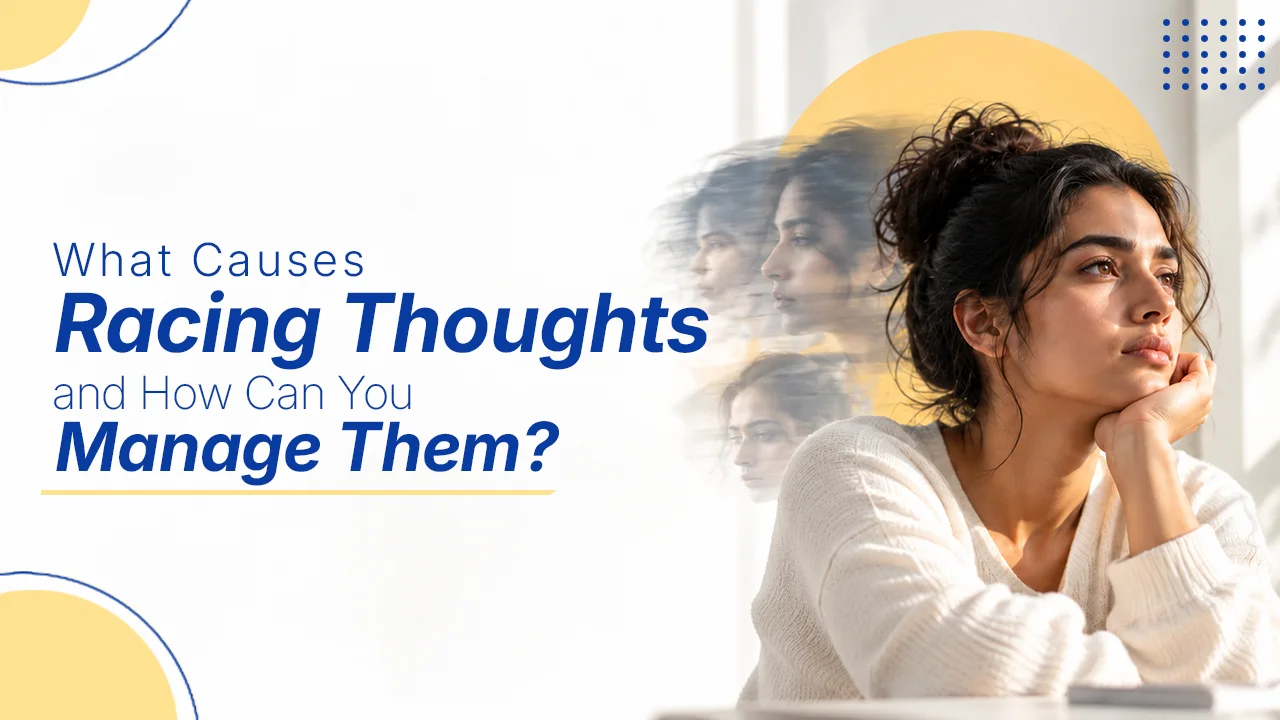
You lie awake at 2 am. Does it feel as though something is wrong with you when your mind will not slow down?Thoughts jump from one worry to the next, replay old mistakes, or rehearse conversations that have not happened. At night it is often worse, and many people lie awake for hours. If you are also dealing with an addiction, the noise can seem to threaten your progress.
Having too many thoughts at once, sometimes described as brain racing, can feel distressing and overwhelming. Racing thoughts are common and usually have an identifiable cause. Once you know what is driving them, there are practical ways to bring them down. This article covers the likely causes, what you can do today, and when a professional assessment is needed.
Key Insights
- Understand that racing thoughts are a symptom, not a diagnosis.
- Learn about common causes, including anxiety, high mood, poor sleep and substance withdrawal.
- Explore practical ways to manage racing thoughts, from slow breathing to regular exercise.
- Recognise when persistent racing thoughts may need professional assessment.
What Are Racing Thoughts, and What Do They Mean?
Quick Answer
Racing thoughts are a rapid, hard-to-control flow of thoughts that jump between topics or loop around one worry. They are a symptom, not a diagnosis. Health services list them among the symptoms of the manic phase of bipolar disorder, [1] and a clinician can assess whether anxiety, sleep problems or other causes are involved.
If your mind rarely seems to switch off, or you find yourself searching for “racing thoughts” or “brain racing”, this is likely the experience you are trying to understand. When your brain seems to be thinking constantly, it may involve racing thoughts or rumination. It differs from rumination, which is repetitive thinking that circles one negative topic.
| Racing thoughts | Rumination | |
|---|---|---|
| Pace | Fast, often jumping between topics | Slower, circling one topic |
| How it feels | Too many thoughts at once | Replaying the same worry or regret |
What Are the Causes of Racing Thoughts?
Quick Answer
Racing thoughts are a symptom of the manic phase of bipolar disorder. Stress, anxiety, caffeine, alcohol and some medicines can also disturb sleep, and cannabis withdrawal commonly brings anxiety and disturbed sleep. [3] A clinician can help work out which apply to you. Racing thoughts can also occur alongside other mental health conditions, sleep problems, medication effects or substance withdrawal.
Withdrawal means the symptoms that can follow stopping or cutting down a substance.
| Cause | What health sources describe |
|---|---|
| Generalised anxiety disorder (GAD), a long-term condition of ongoing, hard-to-control worry | Caffeine, nicotine, alcohol and recreational drugs can worsen anxiety [4] |
| Mania, a period of extreme energy and activity in bipolar disorder | Racing thoughts, little need for sleep and rapid speech [1] |
| Insomnia, meaning trouble falling or staying asleep | Causes include stress, anxiety, alcohol or other substances, and too much caffeine [2] |
| Medicines and medical conditions | Some cold medicines, diet pills and other medicines, and conditions such as thyroid problems, can cause or worsen insomnia [2] |
| Cannabis withdrawal | Anxiety, irritability and disturbed sleep, usually starting 24 to 48 hours after stopping and peak around days 2–3 and may last two to three weeks [3] |
Why Do Racing Thoughts Get Worse at Night?
Quick Answer
Racing thoughts often feel more intense at night because daytime distractions fade, leaving more room for worries and anxious thoughts. Fatigue can also make it harder to manage emotions and quiet the mind. Stimulants such as caffeine and nicotine can increase alertness and anxiety, making it difficult to relax before bed.
Alcohol and recreational drugs can also disrupt sleep and worsen anxiety. If you are in recovery, cannabis withdrawal may contribute to restlessness, irritability and difficulty sleeping, which can make racing thoughts harder to manage. Alcohol withdrawal can cause anxiety, insomnia and restlessness. Severe withdrawal may lead to delirium tremens, a medical emergency. Anyone who regularly drinks heavily should seek medical advice before stopping alcohol use.
If you are looking for ways to calm racing thoughts before sleep, try deep breathing or progressive muscle relaxation, which involves gradually tensing and releasing different muscle groups, as part of your bedtime routine.
How Can You Stop Racing Thoughts?
Quick Answer
Regular exercise, enough sleep, relaxation techniques and less caffeine are self-care steps listed for anxiety. [4] Cognitive behavioural therapy (CBT), a talking therapy, adds a structured way to question unhelpful thoughts. [5] These steps ease symptoms. A lasting pattern still needs an assessment.
- Slow Your Breathing
The NHS suggests breathing in through the nose and out through the mouth, counting steadily from 1 to 5 each way, for at least five minutes. [6]
- Name the Thoughts and Let Them Pass
Say “my mind is racing” and return to what you were doing. CBT includes noticing emotions and physical feelings without reacting to them. [5]
- Give Worries a Place to Wait
Write one line per worry in a notebook and review the list at a set time earlier in the evening.
- Cut Back on Caffeine
It is advised to cut back or quit coffee because caffeine can worsen anxiety. Reduce gradually.
- Move Every Day
Remain physically active most days of the week to help reduce stress.
- Question the Thought
CBT includes questioning unhelpful thoughts and beliefs and considering other ways of looking at things. Ask what evidence supports the thought and what you would say to a friend. You can also challenge irrational thoughts by identifying assumptions and considering whether the available evidence supports them.
- Prepare for Cravings
Write three actions on a card, such as breathing, walking, and calling a named person.
These techniques offer practical ways to deal with racing thoughts by helping you redirect your attention and respond differently to unhelpful thinking patterns.
Treatment for Racing Thoughts
Treatment depends on the cause. There is no single best medicine for racing thoughts. The appropriate medication depends on the underlying condition and severity of the symptoms.
| Cause | Treatment options |
|---|---|
| GAD | Psychotherapy such as CBT, and medicines, with antidepressants as the usual first-line choice [4] |
| Bipolar disorder | Mood stabilisers as the usual first medicines, and talk therapy [1] |
| Insomnia | Changes to lifestyle and sleep habits, with CBT for insomnia helping some people [2] |
| Cannabis withdrawal | Supportive counselling and education, as no medicine is approved specifically for it [3] |
Do not stop or change the dose of prescribed medicine without talking to your doctor. [1]
When Should You Seek Professional Help?
Arrange an assessment if you notice:
- Symptoms of mania, such as little need for sleep, rapid speech and racing thoughts.
- Feeling hopeless, scared or overwhelmed.
- Insomnia has become a problem.
- Racing thoughts that return with cravings or a wish to use again.
- An urge to hurt yourself or others.
If these symptoms persist or interfere with daily life, seek an assessment from a qualified mental health professional. If you are looking for a psychiatric hospital in Bangalore, choose a facility that can provide a comprehensive psychiatric evaluation and explain suitable treatment options based on your needs.
If you need immediate assistance in India, call 112. Tele-MANAS, the Government of India’s mental health helpline, is available at 1-800-891-4416 or 14416.
Support at Jagruti Rehabilitation Centre
If racing thoughts and substance use are linked for you or a loved one, a clinical assessment can clarify what is driving them. Jagruti Rehabilitation Centre offers psychiatrist-led assessment, individual psychotherapy, family counselling, residential rehabilitation programmes, and support for co-occurring mental health and substance use conditions. Recommendations are based on each person’s assessment. To arrange one, call +91-9822207761.