

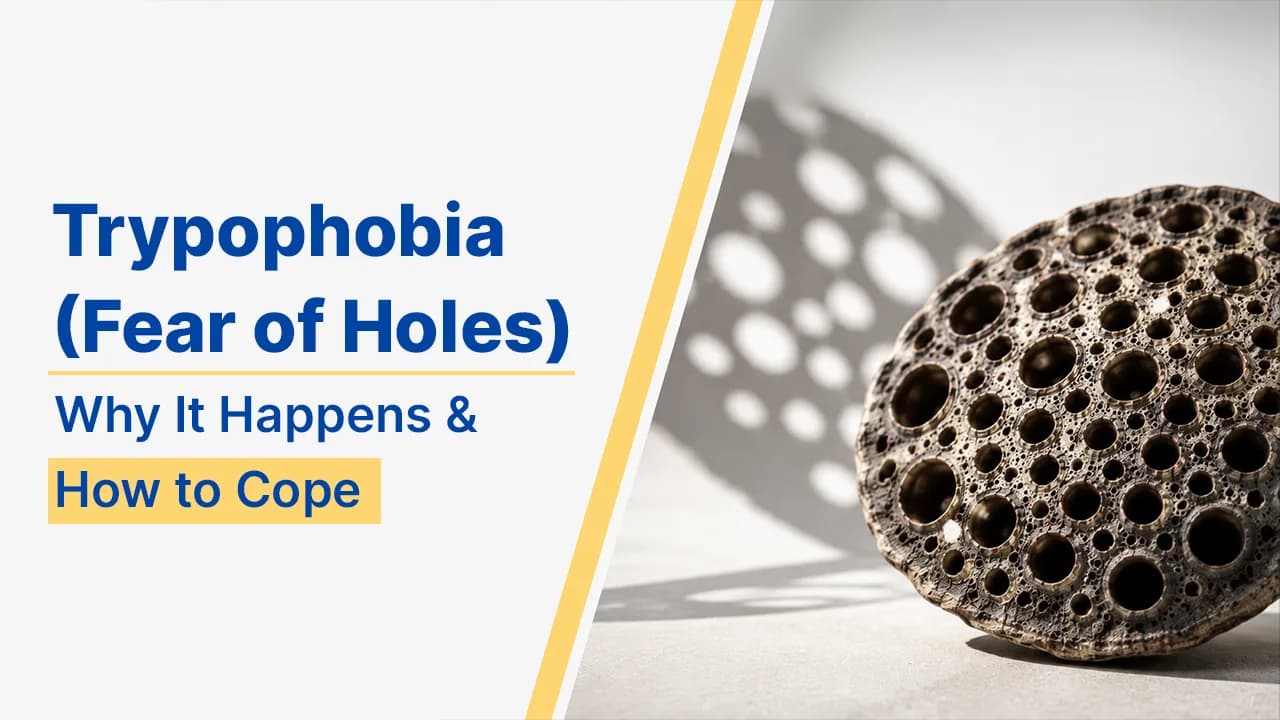
Ever looked at a lotus seed pod, or a slice of honeycomb, and felt your stomach turn for no obvious reason? You're not imagining it, and you're definitely not alone. That reaction has a name: trypophobia, an intense discomfort or fear triggered by clustered holes and repetitive patterns [1]. Although trypophobia isn't listed as a standalone condition in the DSM-5, that doesn't make the experience any less real. For people who feel their skin crawl at the sight of these patterns, the distress exists regardless of whether it has an official diagnostic label.
What is Trypophobia?
At its core, trypophobia is an intense feeling of discomfort or fear when looking at clusters of small holes, bumps, or repeating patterns. The word comes from the Greek words trypa (hole) and phobos (fear), meaning "fear of holes." Some critics have argued that trypophobia isn't a genuine phobia, partly because it isn't formally listed in the DSM-5. But researchers pushing back on that view point out that the DSM-5 doesn't list phobias individually at all - it lays out criteria for what qualifies as one, and by that standard, trypophobia fits.[2] However, there's no doubt that the reactions people experience are real. For some, it's a brief feeling of discomfort. For others, it can trigger intense anxiety or even panic. Our team at mental hospital in Chennai works with anxiety-related conditions like this one regularly. We consistently help people manage symptoms that may be linked to trypophobia, through personalised evaluation and treatment.
Common Trypophobia Triggers
People assume it's just about holes in general. It's more specific, and a bit stranger, than that.
- Natural patterns: lotus seed pods, honeycombs, coral, clusters of bubbles
- Skin-related imagery: pores, rashes, certain skin conditions photographed up close
- Artificial patterns in architecture, fabric, or product packaging
- Digitally edited or exaggerated hole clusters
- Ordinary household objects, like sponges, aerated chocolate, strainers
Here's the strange part. What sends one person into a full-body cringe might do absolutely nothing to someone else. Natural clusters bother some people intensely while artificial patterns leave them cold, and for others it's the reverse entirely.
Symptoms of Trypophobia
Emotional and Psychological Symptoms
- Fear
- Anxiety
- Panic
- Disgust
- Uneasiness
- Irritability
- Feeling overwhelmed
Physical Symptoms
- Goosebumps
- Sweating
- Nausea
- Rapid heartbeat
- An itching sensation
- Dizziness
- Shivering
- Difficulty breathing, in more severe cases
Not everyone gets hit with the full list. Plenty of people feel a small wave of discomfort and move on with their day. Others aren't so lucky, and the physical response lingers well past the moment they've looked away.
What Causes Trypophobia?
Short answer: nobody really knows for certain. Longer answer, a handful of theories keep surfacing in the research:
- Evolutionary theories, where the pattern resembles something historically tied to danger, venomous creatures or disease markers, for instance
- The brain's response to high-contrast visual clusters, which may overstimulate the visual cortex
- Learned behaviour, an association formed after one specific unpleasant experience
- Underlying anxiety disorders that heighten general sensitivity to visual input
- Genetic predisposition, since anxiety traits tend to run in families
- Past traumatic experiences tied to skin conditions, insects, or illness
- Differences in how the nervous system processes sensory information
It's probably not just one of these. Most researchers lean toward some combination, and the exact mix likely differs person to person.[3]
Risk Factors for Developing Trypophobia
Some factors may increase the chances of developing trypophobia. Having a family history of anxiety is one of them. People who already live with an anxiety disorder may also be more likely to experience it.[3] Those who are more sensitive to certain visual patterns or have had upsetting experiences involving skin conditions, insects, or illness may be at a higher risk. Other mental health conditions can also play a role.
That said, having one or more of these factors doesn't mean someone will definitely develop trypophobia. It simply means they may be more likely to experience it.
How is Trypophobia Diagnosed?
There's no dedicated DSM-5 checklist for this one, so diagnosis tends to fall under a broader psychiatric evaluation.[4] That usually means a clinical interview, an assessment of whatever symptoms are showing up, and a look through medical history to rule out other explanations. Differential diagnosis matters quite a bit here too, since the symptom picture can overlap with other anxiety disorders or OCD, and screening for both is fairly standard before settling on a conclusion.
Treatment Options for Trypophobia
Cognitive Behavioural Therapy (CBT)
CBT tends to be the go-to for reactions like this. It works by identifying the thought patterns feeding the fear, then slowly reshaping them over time.
Exposure Therapy
Gradual, controlled exposure to trigger images, guided by a professional, can wear down the intensity of the reaction bit by bit.
Relaxation and Stress Management Techniques
Breathing exercises, progressive muscle relaxation, grounding techniques, these help take the edge off acute symptoms when they hit.
Medications (When Appropriate)
For more pronounced anxiety, a psychiatrist might bring medication into the mix alongside therapy. Not usually the first move, but sometimes a necessary one.
Lifestyle Changes and Self-Help Strategies
- Mindfulness practice
- Breathing exercises
- Better sleep habits
- Regular physical activity
- Limiting trigger exposure, where that's realistically possible
None of this is one-size-fits-all. What helps someone with mild, occasional discomfort looks nothing like what someone dealing with frequent panic responses actually needs.
Can Trypophobia Be Prevented?
Not entirely, if we're being honest. But the risk and impact can both be softened. Managing stress before it builds up, getting mental health support early rather than waiting it out, working through gradual exposure under proper guidance, all of this helps. So does building healthier coping habits generally and staying ahead of anxiety instead of reacting to it after the fact.
When Should You Seek Professional Help?
A few signs suggest it's worth talking to someone rather than white-knuckling through it alone. Symptoms getting in the way of work or relationships. Avoidance behaviours creeping into daily routines. Panic attacks that keep happening. Anxiety that feels severe or won't let up. Real emotional distress, or pulling away from people socially. If any of this feels familiar, a professional assessment can provide far more clarity than trying to self-diagnose online.[5]
How Jagruti Rehabilitation Centre Supports Individuals with Trypophobia
If clustered holes or repeating patterns leave you feeling anxious or unsettled, please know that you're not alone. What you're experiencing is real, and it's okay to seek support if it's beginning to affect your daily life.
At Jagruti Rehabilitation Centre, we take the time to understand your experience before recommending any treatment. Every journey begins with a detailed psychiatric assessment, followed by a personalised care plan designed around your unique needs. Our team of psychiatrists and psychologists uses evidence-based approaches, including Cognitive Behavioural Therapy (CBT) and structured anxiety management techniques, to help you better understand and manage your symptoms.
We also believe that recovery is about more than easing symptoms. When appropriate, we involve family members in the healing process, helping them understand what you're going through and how they can support you. Even after treatment, we continue to provide guidance through aftercare and relapse prevention, so you never feel like you're facing it all on your own.
Whenever you feel ready, we're here to listen, answer your questions, and help you take the next step at a pace that feels comfortable for you.
Conclusion
Trypophobia doesn't have an official entry in the DSM-5, but that hasn't stopped it from causing real distress for the people who deal with it. Between the emotional weight, anxiety, disgust, that overwhelmed feeling, and physical symptoms like a racing heart or nausea, this can genuinely disrupt someone's day-to-day life. The encouraging part is that early assessment paired with evidence-based therapy and steady professional support tends to help. Most people get back to functioning comfortably, even around the exact things that once set them off.