
Rehabilitation Centre in Lucknow
Rehabilitation Centre in Lucknow: Residential Addiction Care for Your Family
Someone in your home is drinking or using drugs, and nothing you have tried has worked. You have tried reasoning, then promising, then one more chance. That usually stops feeling like a plan and starts feeling like a loop. There is a particular tiredness that comes with this, whether you are watching someone you love slip away or you are the one who cannot stop. Either way, treatment is the next question.
What you need now is not another telephone number. It is a psychiatrist who sits with your family member through the week, not once in a while. A clinical team that gives you a straight answer even when the answer is uncomfortable. A treatment plan that does not end the day your family member comes home.
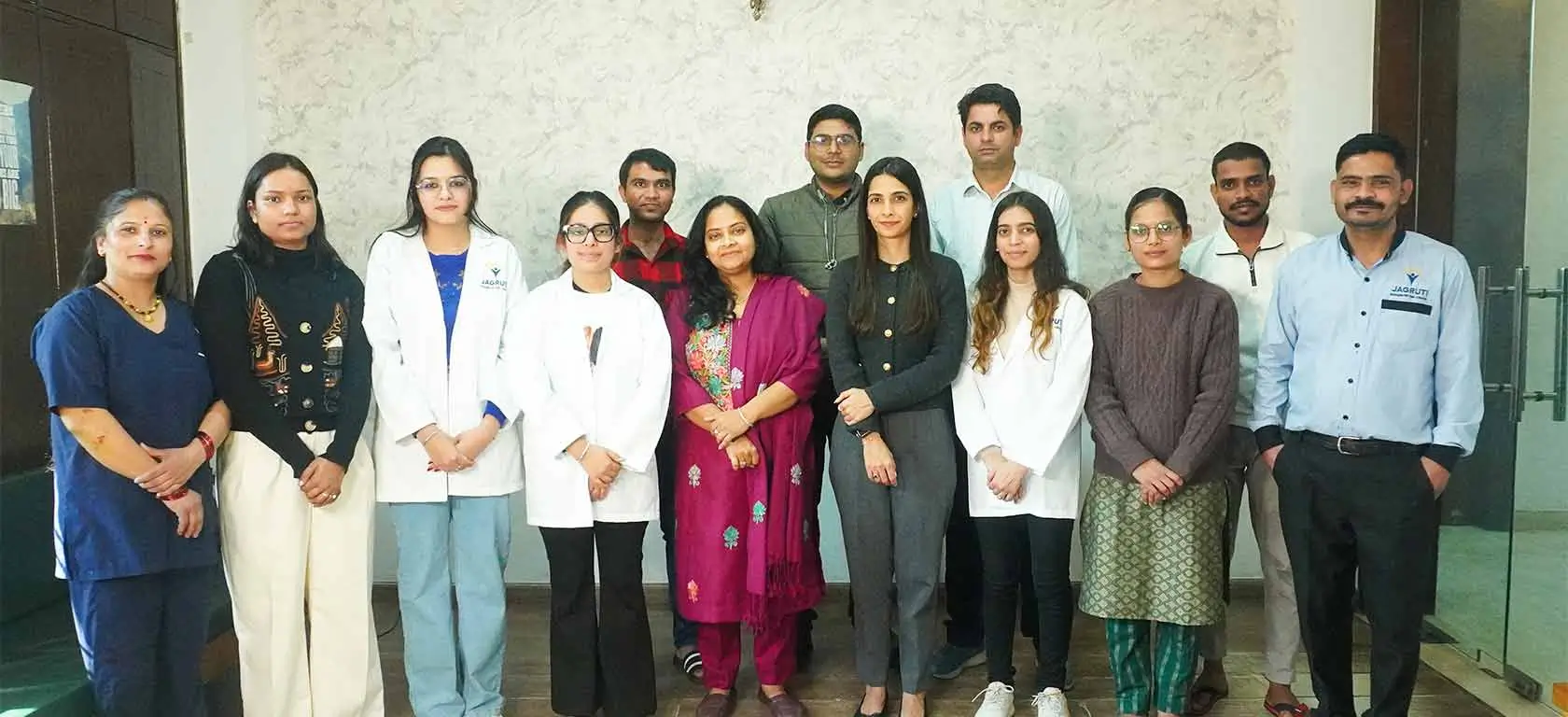
Jagruti Rehabilitation Centre has been providing psychiatrist-led addiction treatment for over 18 years. Founded by Dr. Amar Shinde, we run 17+ centres across India, with 40+ doctors, and have supported more than 82,000 individuals and their families. Our Delhi-NCR centres, in Delhi, Gurgaon, and Noida, serve families from across north India, including Lucknow.
Have questions about how this works for a family in Lucknow? We can answer them.
Call Now→What Substance and Alcohol Use Looks Like in Lucknow, Uttar Pradesh
When a family starts looking for a de addiction centre in Lucknow often do it quietly, without telling relatives or neighbours. The assumption is that this is a private failure, something happening only in their home. The data from Lucknow and the surrounding districts says something different.
Among students, a 2025 study of medical and paramedical students in Lucknow found 46.1% had used a psychoactive substance at some point, with alcohol the most common at 36.6%, followed by tobacco at 22.4% and cannabis at 17.9% [1]. A separate study in Etawah found alcohol prevalence at 19.8% among medical students, most starting after 19 [2]. A 2008 population-based study of urban Lucknow found substance abuse at 34.31% across the general population, not just students [3].
Together, these studies show that this cuts across Lucknow's population rather than sitting in one group. It appears across age groups, occupations and income levels, from daily-wage workers to salaried households.
Wondering if this is serious enough to do something about? A short call with our team will give you a clearer picture.
Call Now→Why Distance From Lucknow Helps in Early Recovery
Most families in Lucknow begin their search with a rehab centre in Lucknow itself. That is a reasonable first step, whether this is the first time you are seeking treatment or you have tried it before. It usually starts with a local clinic, a counsellor nearby, or a short admission somewhere within the city.
An addiction treatment plan can only hold if the surroundings change with it. For someone coming back to the same neighbourhood, the same friends, and the same relatives who have known them since childhood, the pull back to old habits is constant. Recovery needs a different set of mornings, which is difficult to build at home.
Why a Break from Lucknow's Social Fabric Is Needed
Lucknow is a city where families know each other and where neighbours are sometimes relatives too. The family doctor knows your family history. Your colleagues at work may live two streets away. This closeness is one of the city's strengths, but for a family dealing with addiction, it becomes a barrier.
The fear of being seen, talked about, or judged is often the reason families delay treatment for months or years. For families specifically searching for an alcohol rehabilitation centre in Lucknow, the same logic applies. The people and places linked to drinking are still within reach.
When your family member travels to our Delhi-NCR centres, that visibility disappears. There is no one from your social or professional circle nearby. What happens in treatment stays between your family and the clinical team. That privacy belongs to you first when the search is for yourself. For many families, that privacy is the first thing that makes honest treatment possible.
A Different Routine, Away from Familiar Cues
The first weeks of recovery depend on structure: fixed sleep, fixed meals, fixed therapy hours, and someone checking in at every stage. That structure is difficult to sustain at home, where it has its own rhythm and old patterns return quickly.
Why Distance Matters
Leaving Lucknow for treatment is a significant decision, and we understand that. It means rearranging work, explaining an absence to relatives, and trusting a clinical team in another city with someone you love. Families do not take this lightly, and neither do we.
Families from Lucknow who choose our Delhi-NCR centres often say the same thing afterward: the distance felt like a sacrifice at first, and later it felt like the reason treatment was held. Planned visits, weekly family therapy sessions, and regular clinical updates keep you involved throughout. You are not handing your family member over and waiting. You are part of the process, just from a little further away.
Travelling for care is a real decision. Talk it through with our clinical team first.
Call Now→Your Options for Treatment in Lucknow
Understanding what each treatment path can realistically offer makes the decision less overwhelming. Three broad routes usually come up when families in Lucknow begin this search.
Government Facilities in Lucknow
Uttar Pradesh has been expanding its public de-addiction infrastructure. In 2021, under the National Action Plan for Drug Demand Reduction, the state announced 30-bed de-addiction centres for Lucknow and Gorakhpur, plus 10-bed facilities in government hospitals elsewhere [4]. More recently, the state decided to establish de-addiction centres in all government medical colleges.
Several NGO-run Nasha Mukti Kendras also operate in and around Lucknow with state support, offering counselling and rehabilitation at low or no cost [5]. The honest limitation here is not quality of intent but capacity and structure.
Private Rehab Centres in Lucknow
The private rehab centres in Lucknow offer residential programmes, medical detox, counselling, and family involvement. Costs generally range from around ₹12,000 to ₹25,000 per month for basic programmes, with some centres charging higher for more intensive medical care or private rooms.
What varies most is clinical depth. Some private centres have a psychiatrist on-site daily and structured aftercare. Others rely on visiting consultants and taper off psychiatric oversight after detox.
Jagruti's Delhi-NCR Centres
For families from Lucknow, our Delhi-NCR cluster serves as the treatment destination. All three centres are psychiatrist-led residential facilities with 24/7 nursing, medically supervised detoxification, dual diagnosis care, structured family therapy, and a written aftercare plan before discharge.
What sets the programme apart is how the days are structured. Care at Jagruti is built on three active partnerships: between the clinical team and the patient, between the team and the family, and between the patient and the people who love them. Every evening, a psychiatrist reviews the care plan before the day ends. A doctor stays with your family member throughout the programme rather than rotating. Families receive a dedicated weekly session and a written update, so you are not left wondering how things are going. Where addiction overlaps with another condition, both are treated together during the same admission by the same psychiatric team.
Still comparing options for rehab in Lucknow? One call will make the choice clearer.
Call Now→Getting to Our Delhi-NCR Centres from Lucknow
Families from Lucknow usually ask the same practical question once they have decided to explore treatment in Delhi-NCR: how do we actually get there, and how often can we visit? The honest answer is that this is a long journey, not a short commute. Lucknow is roughly 500 km from Delhi-NCR, and the trip takes the better part of a day by road or train.
Getting to Our Delhi Centre (Naraina)
Our Delhi centre is located in Naraina, West Delhi.
| From City | Distance | Best Option | Approx Time |
|---|---|---|---|
| By road | 480-530 km | Drive via Agra-Lucknow Expressway and Yamuna Expressway | 7-9 hours depending on traffic and stops |
| By train | 490-515 km | Trains from Lucknow Charbagh or Lucknow Junction to New Delhi, then take auto or cab to Naraina | 7-9 hours by train, plus 30-40 minutes to Naraina |
| By flight | 424 km (air) | Fly from Lucknow (LKO) to Delhi (DEL), then cab to Naraina | 1-1.5 hours in the air, plus airport transfers and 30-40 minutes to the centre |
Getting to Our Noida Centre
Our Noida centre is in Sector 30, near Noida City Centre Metro Station.
| From City | Distance | Best Option | Approx Time |
|---|---|---|---|
| By road | 477-520 km | Drive via Agra-Lucknow Expressway and Noida-Greater Noida Expressway | 7-8 hours depending on traffic and stops |
| By train | 480-510 km | Train from Lucknow to Anand Vihar Terminal, then metro to Noida City Centre | 6-7 hours by train, plus 30-40 minutes by metro |
| By flight | 424 km (air) | Fly from Lucknow (LKO) to Delhi (DEL), then cab or metro to Noida | 1-1.5 hours in the air, plus 1-1.5 hours to Noida |
Getting to Our Gurgaon Centre
Our Gurgaon centre is in Sector 42, close to Golf Course Road.
| From City | Distance | Best Option | Approx Time |
|---|---|---|---|
| By road | 460-500 km | Drive via Agra-Lucknow Expressway and Yamuna Expressway, then take the Outer Ring Road or MG Road to Sector 42 | 6-8 hours depending on traffic and stops |
| By train | 490-520 km | Trains from Lucknow to Gurgaon | 8-10 hours by train, plus 25-30 minutes by cab |
| By flight | 424 km (air) | Fly from Lucknow (LKO) to Delhi (DEL), then cab to Gurgaon | 1-1.5 hours in the air, plus 40-60 minutes to Gurgaon |
A treatment stay of 30 to 90 days is a long stretch to be away from someone, and most Lucknow families cannot make the trip every week. What the programme does instead is bring the family into the process without requiring constant physical presence.
The admission team can help you plan the first trip and explain what to bring. After admission, regular clinical updates by phone mean you are not dependent on being physically present every week.
Planning the first visit from Lucknow? Our admission team can help you map it out.
Call Now→What Treatment at Jagruti Lucknow Looks Like
The question families ask most often is not about medication or therapy models. It is simpler than that. What will the days actually look like for my family member once they are there? Here is how the programme runs at our Delhi-NCR centres.
The First Few Days
Your family member is not handed a form and shown to a room. The first step is a complete clinical assessment, where a psychiatrist goes through their substance history, medical background, sleep and appetite, and how they are functioning right now. We ask you to be present for this, because what you have watched at home over the last few years often fills in what your family member cannot or will not say.
By the end of that assessment, a written plan is outlined in detail covering how long treatment is likely to run, and what the therapy schedule looks like.
Stabilisation and Therapy Sessions
For most patients, treatment begins with medically supervised detoxification, handled by our nursing team inside the centre. This phase usually runs seven to fourteen days, depending on the substance and how heavy the use has been. Detox on its own does not resolve addiction. It settles the body so that therapy can work, and until that happens, a person cannot really engage with counselling or group sessions.
Once stable, your family member moves into structured therapy. Cognitive Behavioural Therapy (CBT) and Dialectical Behaviour Therapy (DBT) help identify the thinking patterns that lead back to substance use. Individual counselling gives them a private space to work through their own history along with group sessions that put them alongside others dealing with similar struggles. Wellness activities, art, music, and physical recreation are built into the weekly routine.
How Families Stay Involved
You attend a dedicated family session every week and receive a written update, so you are not left wondering how things are going. Where substance use overlaps with a mental health condition, the same psychiatric team treats both during the same admission.
Programme Length
Programmes run for 30, 60, or 90 days. A shorter stabilisation of seven to ten days is available for crisis situations, followed by outpatient care. The clinical team recommends a duration once the full assessment is done. For patients who have relapsed before, or who are carrying a dual diagnosis, 60 to 90 days is often advised.
After Discharge
Before your family member leaves, the team builds a relapse prevention plan around their specific triggers, their home situation, and the environment they are returning to. Follow-up calls are scheduled at 30, 60, and 90 days to review medication, watch for early warning signs, and adjust the plan where it is required. Family counselling continues for months after discharge.
Wondering how long treatment should run and what it involves?
Call Now→Local Resources and Helplines in Lucknow
If you or your family is still gathering information, or if you need someone to talk to before deciding on treatment, these are the numbers and services that operate in Lucknow and Uttar Pradesh.
National Helplines
Tele MANAS (14416 or 1-800-891-4416)
Run by the Ministry of Health and Family Welfare, Tele MANAS gives families across India a free number to call when they need to talk to someone trained, at any hour. You dial 14416, or the toll-free line 1-800-891-4416, and you are connected to a counsellor who speaks your language [6]. This is a confidential call.
MANAS National Narcotics Helpline (1933)
MANAS (Madak Padarth Nishedh Asoochna Kendra) was launched on 18 July 2024 under the Narcotics Control Bureau, Ministry of Home Affairs [7]. Call 1933 and you can speak to someone about treatment options and counselling, with calls passed on to the Ministry of Social Justice and Empowerment helpline 14446 where further support is available.
Uttar Pradesh State Resources
UP Anti-Narcotics WhatsApp (8756128434)
The Uttar Pradesh government has issued a dedicated WhatsApp number for citizens to confidentially report illegal drug activity [8]. This was introduced as part of a state-wide enforcement drive against the illegal trade of narcotic medicines, particularly codeine-based cough syrups.
Government Facilities in Lucknow
King George's Medical University (KGMU), Department of Psychiatry
KGMU's psychiatry department runs outpatient services, de-addiction clinics, and a technology overuse clinic [9].
Balrampur Hospital, Mental Health Unit
Balrampur Hospital in Golaganj runs a mental health unit (Man Kaksh) with counsellors providing de-addiction support [10].
NGO-Run Nasha Mukti Kendras in Lucknow
Several NGO-run centres operate in and around Lucknow with state support under the UP Prohibition Department. These provide counselling, treatment, and rehabilitation services, often at low or no cost.
Bharatiya Samaj Seva Sansthan - Barfkhana, Misri Ka Bagh, Thakurganj, Lucknow. Phone: 9935778857 [5]
Prema Samiti- Chinhat, near Goyal Sheet Grah, Lucknow. Phone: 9450645362 [5].
What These Numbers Can and Cannot Do
Government helplines and public facilities serve a specific purpose. They give you guidance when you need it, they let you report drug-related activity, and they tell you what public treatment options exist in Lucknow. What they are not set up to offer is a same-day bed, a psychiatrist who sees your family member daily, or a residential programme with family therapy built into the week. If round-the-clock care is what your family member needs, that usually means a private centre.
Helplines can guide you. To understand what care your family member needs, speak with our clinical team.
Call Now→Frequently Asked Questions
Do you have a rehab centre in Lucknow?
What addictions do you treat at Jagruti?
My husband drinks every day. What does alcohol treatment involve?
My son refuses to go to rehab. What can we do?
Are family members allowed to visit during treatment?
How long does rehab treatment take?
What should we pack for admission at Jagruti rehab centre in Lucknow?
How do I choose the right rehab centre for my family member?
Do you treat female patients?
What if my family member has a mental health condition along with the addiction?
We live in Lucknow. Can you still help us?
What happens after treatment ends and we go home?
How do we travel from Lucknow to your Delhi-NCR centres?
What happens if there is an emergency and we are in Lucknow?
Is treatment confidential from employers or family in Lucknow?
Can my family member be admitted the same day we call from Lucknow?
Get an appointment for
free consultation
References
[1] Singh, H., et al. (2025). Psychoactive substance use among medical and paramedical undergraduate students of Lucknow. Journal of Education and Health Promotion, 14, 88. Available at: https://pubmed.ncbi.nlm.nih.gov/40144188/
[2] Kumar, S., et al. (2015). Epidemiology of substance abuse in the population of Lucknow. Journal of Oral Biology and Craniofacial Research, 5(3), 128–133. Available at: https://pmc.ncbi.nlm.nih.gov/articles/PMC4623888/
[3] Chak, I. K., et al. (2025). An assessment of prevalence of alcohol consumption, drinking behaviors, and alcohol use disorders among medical students of UPUMS, Saifai, Etawah, Uttar Pradesh: A cross-sectional study. Indian Journal of Community Health, 37(3), 431–435. Available at: https://www.iapsmupuk.org/journal/index.php/IJCH/article/view/3330/1691
[4] Department of Social Justice & Empowerment, Ministry of Social Justice & Empowerment, Government of India. (n.d.). National Action Plan for Drug Demand Reduction (NAPDDR). Available at: https://socialjustice.gov.in/schemes/42
[5] Prohibition and Social Upliftment Department, Uttar Pradesh. (n.d.). Nasha Mukti Kendras: Details of Nasha Mukti Kendras operating in Uttar Pradesh. Available at: https://www.upmadyanishedh.in/institutions
[6] Tele-MANAS, Ministry of Health and Family Welfare, Government of India. (n.d.). Tele-MANAS. Available at: https://telemanas.mohfw.gov.in/
[7] Ministry of Home Affairs. (2025, August 6). National narcotics helpline 'MANAS' (Press Release ID: 2153181). Press Information Bureau, Government of India. https://www.pib.gov.in/PressReleasePage.aspx?PRID=2153181
[8] Statesman News Service. (2025, December 5). UP government cracks down on illegal drugs; 128 firms booked for codeine misuse. The Statesman. Available at: https://www.thestatesman.com/india/up-government-cracks-down-on-illegal-drugs-128-firms-booked-for-codeine-misuse-1503522240.html
[9] King George's Medical University. (n.d.). Department of Psychiatry. Available at: https://www.kgmu.org/department_details.php?dept_id=26&dept_type=2
[10] Balrampur Hospital. (n.d.). Historical glimpse (1869). Available at: http://www.balrampurhospital.com/About.aspx
Medical Disclaimer
This page is published by Jagruti Rehabilitation Centre for general information only. It is not medical advice and should not be used to diagnose or treat any condition on its own. Content is reviewed by our clinical team under the supervision of Dr. Amar Shinde (MBBS, DPM, FIPS), Senior Psychiatrist.
Start With a Conversation
Help is closer than it feels right now. We are here whenever you want to reach out. One call is enough to begin. You will know what your family member needs, whether that is our programme or care closer to home.